
Estimate rental-car mileage by listing the journeys you expect to drive, multiplying repeated trips by their frequency, and adding collection, return and optional travel separately. Compare that itinerary with the written mileage terms in the quotation. A route estimate helps you choose an arrangement; it does not establish a mileage allowance or guarantee the final odometer reading.
For a longer stay, start with DNT’s monthly rental guide and then build the usage estimate below. No daily allowance, unlimited-mileage promise or additional-kilometre rate is stated here. Those are booking terms to obtain from the provider.
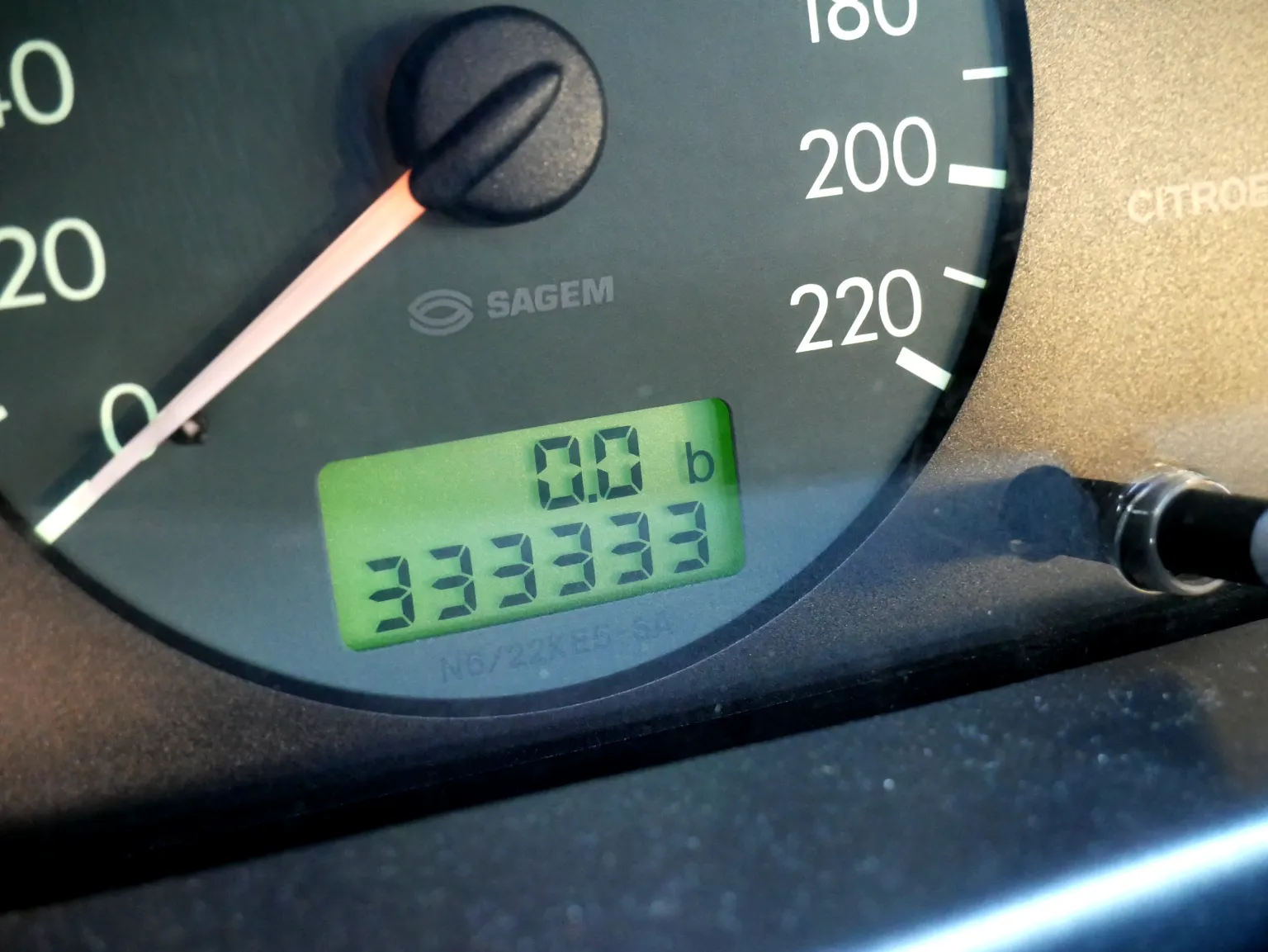
Generic odometer example, not a DNT vehicle or a rental mileage record. Photo: Santeri Viinamäki, 27 January 2017, CC BY-SA 4.0.
Separate the three numbers that people confuse
Your planned distance is the travel you currently expect to make. The included allowance is the distance described in the agreed rental terms. The actual distance is established from the vehicle’s recorded use during the rental. These numbers can differ without any error in the calculation.
For example, a route worksheet may show 900 kilometres, while a quotation describes its allowance using a daily or rental-period rule. You cannot decide whether the arrangement fits merely because both documents mention kilometres. First establish the period, calculation method and treatment of changed travel. Keep a mileage question marked unanswered until the provider has clarified it.
Avoid using “mileage” to mean fuel economy in the same worksheet. Fuel consumption concerns how much fuel a vehicle uses; rental distance concerns kilometres travelled and the applicable booking terms. A fuel-efficient vehicle does not automatically come with a larger distance allowance.
Make a journey list before calculating a total

Start at the agreed collection point and end at the agreed return point. Between them, list accommodation changes, work journeys, appointments, errands and outings. Use the addresses you actually intend to visit, including the appropriate entrance when that affects the approach.
Give each line a frequency and a distance basis. A return commute made on twelve working days is different from a one-way journey made twelve times. A hotel-to-office-to-client-to-hotel circuit needs its own sequence; doubling the first leg leaves out the client visit.
The following worksheet uses invented distances to demonstrate the calculation. They are not verified distances between Malaysian locations, rental allowances or a DNT quotation.
| Journey category | Illustrative distance basis | Frequency | Planned distance |
|---|---|---|---|
| Collection point to accommodation | 18 km, one way | Once | 18 km |
| Accommodation to work and back | 32 km, return | 12 days | 384 km |
| Appointment circuit with two stops | 46 km, complete circuit | Twice | 92 km |
| Local errands | 14 km, complete outing | Six outings | 84 km |
| Accommodation to return point | 21 km, one way | Once | 21 km |
| Base scenario | 599 km | ||
| Optional weekend outing | 110 km, return | At most twice | Up to 220 km |
| Base plus both optional outings | 819 km |
This format exposes an assumption that a single total hides. Someone reviewing the enquiry can see that the optional outings add 220 kilometres and ask whether they are likely. If one outing is cancelled, remove that row’s occurrence rather than rebuilding the estimate from memory.
Count rental days and driving days separately
A vehicle can remain rented on a day when you do not drive it. Conversely, one driving day may contain several separate journeys. Use the actual number of occurrences for your route estimate. Use the agreed booking dates and terms when asking how an allowance is calculated; do not silently substitute working days for rental days.
For corporate rental enquiries, nominate the person who maintains this worksheet. If colleagues each submit a separate estimate, confirm whether their journeys overlap or involve the same vehicle at different times. Adding everyone’s complete commute can overstate use, while keeping only the first traveller’s plan can omit later assignments.
Check routes consistently and record the assumptions

Use a current driving-route tool to estimate each movement. Check that the starting point, destination, units and transport mode are correct. A saved estimate for a previous hotel is not automatically suitable after an accommodation change.
Google’s official directions guide explains adding destinations, rearranging stops and choosing route options. Use those controls to represent the order you intend to travel. Record whether your worksheet uses a complete circuit or individual legs so that you do not count both.
Note the date of the route check and any selected preferences that materially affect the estimate. Different route choices can produce different distances. The purpose is a reproducible planning basis, not a prediction accurate to the last kilometre. A map also does not establish whether the rental agreement permits a destination or type of use.
Avoid two common spreadsheet errors
First, check the units before combining values. A number copied from a miles-based display cannot be added directly to a kilometre worksheet. Second, distinguish a daily total from a single journey. Label “32 km return commute” explicitly, rather than leaving “32 km” for someone else to interpret.
If a route is still unknown, leave a visible question rather than entering zero. Zero means no distance is expected; unknown means the plan needs another decision. That difference matters when a quotation is selected before the itinerary is complete.
Describe uncertainty using scenarios
A useful estimate has a base case for confirmed movements and an upper planning case for identified optional movements. The difference should have a reason: two possible outings, an additional site visit or a second collection trip. Avoid adding an unexplained percentage and presenting it as a contractual buffer.
In the example, the base case is 599 kilometres and the optional-outing case is 819 kilometres. If the team later adds a 70-kilometre appointment circuit, the revised upper case becomes 889 kilometres. Keep that change as a separate dated line. It shows exactly why the earlier estimate no longer describes the full plan.
When comparing offers, send both cases rather than choosing the lower number to obtain a more attractive headline quotation. The monthly rental cost guide can help organise the other scope questions. Two prices are difficult to compare when one provider has considered the complete itinerary and another has only seen the base commute.
See why identical headline totals can behave differently
Consider a fictional five-day itinerary of 20, 20, 120, 20 and 20 kilometres. Its total is 200 kilometres. Now compare two hypothetical descriptions: one says 40 kilometres on each rental day, while the other says 200 kilometres across the booking. The multiplication looks identical, but the third day raises a different question under each description.
Under the first description, ask whether the unused distance on quieter days can be pooled and what happens on the 120-kilometre day. Under the second, confirm that the figure really applies across the whole agreed period and whether other conditions affect its use. Without those answers, do not conclude that the offers are equivalent or calculate an extra charge.
These are deliberately invented examples, not available DNT packages. Their purpose is to show why the busiest day belongs in the enquiry when the quotation refers to daily usage. Keep a dated breakdown if your itinerary has one unusually long movement. It helps the provider explain the actual arrangement against the journey you intend to make rather than against an average that conceals it.
Ask how the written mileage terms work

Use your itinerary to ask a short set of precise questions. Is the allowance measured daily, across the whole booking, or over another stated period? How is additional distance calculated? Does a longer rental change the allowance, and how would a revised itinerary be handled?
Do not assume that a whole-period total answers every question. If a quotation uses a daily rule, ask how high-use and low-use days are treated. If it uses a rental-period rule, confirm which collection and return times define that period. These are requests for the provider’s actual terms, not statements that DNT offers any particular calculation.
Keep the reply with the quotation version it explains. A later verbal discussion about a different vehicle or duration should not be mistaken for an amendment to every term. Before accepting a revised offer, check that its mileage treatment still corresponds to the itinerary you supplied.
For longer rental planning, describe the extra movements as well as the extra days. An additional week at the same hotel and a week of visits to several locations can involve very different usage. Availability and revised terms need confirmation before an extension is treated as agreed.
Have a route estimate but an unanswered allowance question? Ask DNT about the mileage terms for your planned rental. Include the dates and estimated journeys so the reply can address the same proposed scope.
Use odometer readings to review the plan
At collection, record the starting reading with the representative and retain the handover documentation. Ask about a reading you cannot interpret instead of guessing which dashboard display represents the vehicle’s total distance. Do not change vehicle settings while driving to investigate it.
For a longer rental, make an occasional comparison while parked. Subtract the starting reading from the current reading to understand distance used so far. For example, fictional readings of 42,150 and 42,530 kilometres indicate 380 kilometres travelled between those records. That arithmetic describes use; it does not calculate a charge without the agreed terms.
Suppose the first week involved extra meetings that will not recur. Multiplying that week’s use by the remaining weeks may overstate the revised plan. Instead, identify which completed movements were exceptional and rebuild the remaining route list. Equally, a new regular assignment should appear as a repeated future movement, not as one isolated extra trip.
For airport collection, the KLIA rental guide also covers collection and return planning. Record the final reading during your own agreed return handover. Keep the actual distance, the agreed allowance and any explanation of charges separate. A planning estimate alone cannot establish the final amount payable or resolve a disagreement about rental terms.
Keep self-drive distance separate from chauffeur duration

A mileage worksheet can help describe a journey, but it is not a complete brief for travel with a driver. Waiting, pickup appointments, additional stops and the expected finish time remain relevant even when the distance is modest. Use the chauffeur service page when that is the arrangement you need.
For self-drive rental, combine the distance worksheet with passenger and luggage needs. Use the car rental service page to discuss the booking and the DNT fleet references to describe the category you are considering. Ask about the actual offered vehicle and permitted use. A longer journey with little luggage can present a different selection problem from a short journey carrying several people and bulky bags. Include those differences in the same enquiry so distance and practical suitability are assessed together.
Share the worksheet without unnecessary personal details
For a group or company booking, separate the route estimate from private passenger information. A coordinator usually needs the agreed meeting locations and travel pattern to explain mileage; a public spreadsheet does not need everyone’s personal phone number, identity document or unrelated appointments. Share booking details through the appropriate private enquiry channel rather than putting them in a publicly accessible example.
Keep one clearly named current version. If a colleague changes an appointment, record whether the new route replaces the earlier visit or adds another movement. Otherwise, two versions can circulate with different totals and neither recipient knows which figure to assess. Archive the superseded estimate alongside the revised quotation so that the sequence remains understandable. This is especially useful when purchasing staff and travellers are different people.
Send an estimate the team can actually assess
A useful enquiry contains the rental dates, collection and return locations, the base route pattern, the optional journeys and the estimated range. State which routes are still uncertain. Attach a readable summary rather than an unexplained spreadsheet total or a long chain of map screenshots.
For example: “Our route worksheet currently totals about 600 kilometres, with two optional outings taking the planning case to about 820 kilometres. These are estimates. Please confirm the mileage terms applicable to the proposed vehicle and rental dates.” These rounded numbers refer only to the fictional worksheet above.
Use the DNT contact page to discuss your own plan. Before booking, check that the written quotation and confirmed arrangements answer the mileage questions you raised. Keep the worksheet as a planning aid and update it when the journey changes; rely on the agreed rental documentation for the applicable terms.
Send DNT your rental dates and route estimate. Include the base itinerary and any optional journeys so the team can assess the same scope.
Photograph credits
These genuine photographs provide illustrative travel context. Stock subjects are not identified as DNT staff, customers or fleet. Historical destination photographs do not establish current access or pickup arrangements. Only proportional resizing and WebP conversion were performed; each derivative retains its source licence.
- Regional Electronic Odometer: Santeri Viinamäki, photographed 2017-01-27, CC BY-SA4.0.
- Pexels 7964204: Felicity Tai, Pexels License.
- Pexels 3885589: Gustavo Fring, Pexels License.
- Pexels 13060769: Srattha Nualsate, photographed 2016-11-04, Pexels License.
- Pexels 7446974: Gustavo Fring, photographed 2021-03-11, Pexels License.
- Pexels 8943323: Mikhail Nilov, photographed 2021-07-18, Pexels License.